OCD (obsessive compulsive disorder) is not my area of expertise so I refer out for anything more than mild/moderate OCD (which is very common in my practice as a natural part of the neuroplastic illness cycle), but I am seeing it more in my practice these last years since COVID, so wanted to give people some understanding and resources to get better.
What Is OCD?
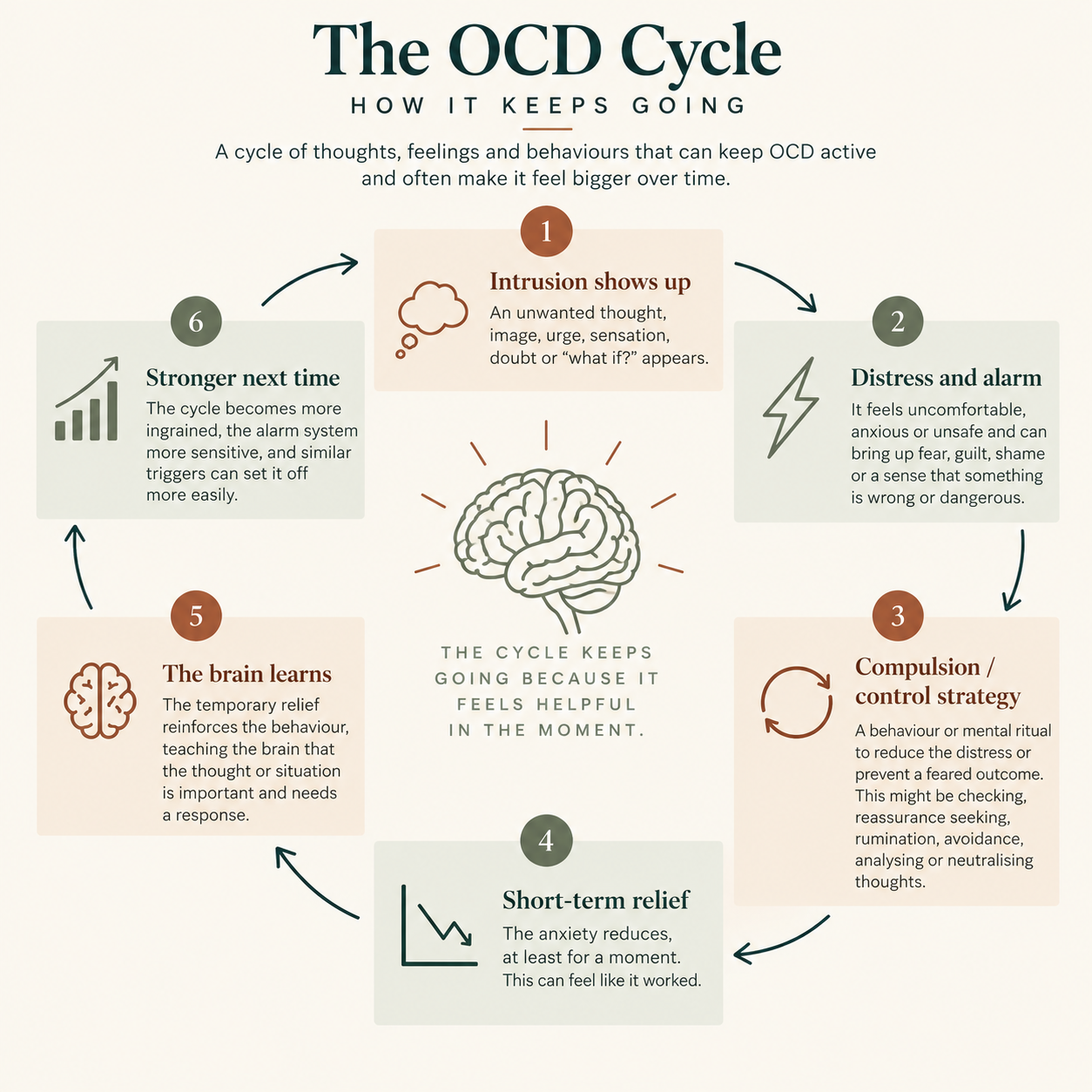
Obsessive-Compulsive Disorder (OCD) is a mental health condition characterised by recurring, unwanted thoughts, images, sensations or doubts (obsessions) and repetitive behaviours or mental rituals (compulsions) intended to reduce distress, prevent feared outcomes or gain certainty. Compulsions can include checking, reassurance-seeking, avoidance, rumination and mental reviewing. Although they may bring temporary relief, they reinforce the cycle, teaching the brain to treat uncertainty and intrusive experiences as threats that require action. OCD can become profoundly distressing and disruptive, but it is treatable, and recovery is absolutely possible. Below is a visual representation of the cycle. Community members will notice how similar it is to our symptom cycle that we work with together. The commonalities are due to it being the same brain alarm system causing loops of symptoms, whereas the OCD cycle creates loops of compulsions. People I work with have the symptom cycle as their primary area of concern with associated patterns of personality, emotional processing and often trauma, with OCD a milder concern. People I refer out have the OCD cycle as their primary area of treatment need.
Foundations Of Recovery
OCD can be an extraordinarily distressing condition. It can hijack your attention, fill ordinary moments with doubt and urgency, and leave you feeling as though your own mind has become somewhere you cannot find peace. It can disrupt our sense of self when we believe thoughts, or think the condition is who we are. For some people, it becomes so consuming that their lives gradually shrink around the need to prevent something terrible from happening, resolve uncertainty, or find relief from thoughts and sensations that feel unbearable.
And yet, people absolutely can recover from OCD. People learn to live freely and meaningfully even when occasional intrusive thoughts or urges return as normal parts of human vulnerability. But recovery asks something of us. It involves understanding what our brain has learned, recognising how we may be participating in cycles that maintain our distress, and gradually developing different ways of responding. These are often deeply ingrained patterns, sometimes practised thousands of times over many years. Changing them requires patience, support, courage and, above all, a willingness to practise.
Talk therapy will NOT work for OCD. I cannot emphasise this enough. Recovery is behavioural therapy, meaning we actively participate in doing new things to change the cycle. It is not easy. You won't feel ready. But you are the only person who can teach your brain a new way to respond to thoughts, sensations, stimuli, and life.
I think this is one of the most important ingredients in recovery, not just from OCD, but from many of the psychological difficulties we encounter in life. When OCD is severe, it’s entirely understandable to feel helpless. Your brain is generating frightening thoughts, doubts, sensations and urges that you didn’t ask for. You may feel as though this is simply happening to you, and in many respects, that is how it begins. If you get stuck in 'woe is me, this is not fair, other people need to make this better for me' then your symptoms will increase.
You didn’t choose OCD. You didn’t choose the experiences, vulnerabilities or circumstances that may have contributed to it. You certainly don’t deserve the suffering it causes. And yet, at some point, recovery invites us to say: Well, shit. It’s not my fault I’m here. I don’t deserve this. It’s not fair. And it’s mine. That is radical acceptance of reality, and radical responsibility that you have agency over your part. YOU have to begin, commit and stick to your recovery (as in all recoveries!)
It means recognising that although we may not have chosen the difficulties we’re living with, we can develop influence over how we respond to them. Other people can support us, teach us, treat us, love us and help us find our footing. Sometimes we need support just to begin. But nobody can do the learning and practising for us.
There is an important distinction between responsibility and blame. Blame keeps us looking for someone or something to hold accountable and our ups and downs of our own cycle will be externalised as someone's fault, or due to external circumstances. Either ourselves, or someone else, often both, will be found at fault for our condition or symptoms. Responsibility asks what is available to us now, given the circumstances we’re in. In OCD, this becomes particularly powerful because compulsions can make us feel as though we have no choice. We must check. We must analyse. We must seek reassurance, avoid the situation, or work out what a thought means. Of course, where harm has been perpetuated on us in our past, this is something to understand and heal with support. We are not responsible for that, that would be blame. We are still responsible for working with reality as it is now.
Gradually recognising our capacity to participate in recovery can itself begin to loosen the sense of helplessness. It is being willing to begin to start to see we have influence, instead of denying that we are the only ones who can change our brain and live the life we want outside of OCD.
Robust psychoeducation essential to meaningful OCD treatment. Without understanding OCD, it’s remarkably easy to personalise everything your mind produces. An intrusive thought becomes evidence about your character. Anxiety becomes evidence that something is wrong. Uncertainty becomes a problem that must be solved. Even the presence of a symptom can become another source of obsessive analysis.
The more seriously we take these experiences as meaningful warnings, or signs of who we are as a person, the more compelling the compulsions become. OCD typically involves a cycle in which an intrusive thought, image, sensation or doubt triggers distress. The person responds with something intended to reduce that distress or prevent a feared outcome. This might involve visible behaviours such as checking, washing or asking for reassurance, but it can also involve entirely internal processes: rumination, mental reviewing, neutralising thoughts, monitoring feelings or trying to establish certainty.
The compulsion may bring temporary relief, but it also prevents the person from learning that uncertainty and discomfort can be tolerated without performing the ritual. Over time, the brain becomes increasingly practised at treating the obsession as important and responding with the same familiar strategy.Psychoeducation helps us recognise these processes as processes of the brain and mind. We can go from being totally swept away by our thoughts, sensations, compulsions to...........
Ah, my brain is producing another intrusive thought. There’s that familiar urge to analyse it. I recognise this cycle. This is where I can practice the new skills I am learning in therapy (choice, agency, new paths available)
That understanding creates some psychological space between who we are and what our mind is doing. We can begin to observe our thoughts without automatically treating them as facts, threats or reflections of our identity. It also helps us recognise that rumination is frequently a compulsion, even when it feels like sensible problem-solving. People can spend hours trying to understand why they had a thought, whether it means something, or whether they have finally found the answer that will allow them to relax.
Unfortunately, the search for absolute certainty tends to strengthen the very cycle they’re trying to escape. Psychoeducation should also include understanding how attention, learning, avoidance, reinforcement and neuroplasticity contribute to these patterns. OCD is associated with differences in brain circuits involved in threat, habit, error monitoring and cognitive control, alongside genetic, psychological and environmental influences. The brain remains capable of learning throughout life, and effective treatment can change how these systems function. Once patients learn this, it strengthens their sense of internal influence, which is 100% necessary to heal.
Non stop learning online itself can become another compulsion if we use it to endlessly research, analyse or reassure ourselves. Its purpose is to help us recognise the cycle and practise something different, rather than to explain every thought or sensation perfectly. Once we understand, insight has to turn into action. Recovery is BEHAVIOURAL therapy, it is action, doing different.
Many compulsions are attempts to manage ordinary, if sometimes extremely intense, aspects of human experience: uncertainty, distress, fear, guilt, shame, responsibility, bodily discomfort and difficult emotions. We may not have the skills and capacities we need yet, to lean into alternative ways to meet these aspects of being human. This is where I think additional learning and practice can be so valuable for some people. These are skills we teach in Befriend by the way!
When the brain has learned to respond to these experiences through rumination, avoidance or compulsive behaviour, those strategies can become something of a one-trick pony. We feel uncomfortable, so we try to make the discomfort disappear. We feel uncertain, so we search for certainty. We experience an unwanted thought, so we attempt to neutralise it.
Recovery involves gradually developing a much broader repertoire of responses. Think of it like building new lanes alongside the ones our brain currently has. This is where skills such as radical acceptance, mindfulness, distress tolerance, emotional regulation, somatic tracking, psychological flexibility and self-compassion can be so empowering.
Radical acceptance helps us acknowledge what is happening without exhausting ourselves fighting reality. Distress tolerance helps us discover that we can experience difficult internal states without urgently needing to escape them. Emotional regulation involves developing flexible ways to understand, respond to and move through our emotions, including how we relate to the sensations accompanying them. Mindfulness allows us to notice our thought processes without getting swept away in them.
These are learnable skills, but learning them takes practice. And I mean practice, practice, practice. Reading about mindfulness doesn’t automatically make us mindful. Understanding distress tolerance doesn’t mean we suddenly have it when our anxiety reaches a nine out of ten. Knowing that uncertainty is unavoidable doesn’t necessarily make us willing to experience it. In a social media world right now of information overload, and content about mental health being everywhere, people are often confusing knowing, with the actual capacities to live differently.
We develop these capacities through repeated experiences of responding differently, ideally beginning with manageable challenges and building over time. Support, modelling, encouragement and specialist treatment can make this learning much more accessible. Some people understandably arrive in treatment desperate for a quick fix, which is a hallmark of high distress. They want someone to take the fear away, make the thoughts stop, or provide the answer that will finally make everything feel okay.
But the deeper work often involves developing confidence in our capacity to meet life without needing those guarantees. And once these skills become part of how we live, they belong to us. We can draw on them in relationships, illness, uncertainty, grief, work and all the other challenges of being human.
Self-compassion deserves particular attention because shame and self-criticism can be such powerful features of OCD. Many people with OCD are deeply distressed by the content of their intrusive thoughts or the overwhelming nature of compulsions. They may fear that having a thought means wanting it, believing it, or being capable of acting on it. Others feel ashamed of their compulsions, frustrated by their inability to stop, or embarrassed that something which appears simple to other people can feel impossible to them.
Self-compassion allows us to begin relating to this suffering differently.We slowly move from: Why am I like this? What’s wrong with me? Why can’t I just stop thinking about it? Towards: My brain is really struggling in this one moment. This is causing genuine distress, and I deserve compassion for that. What would help me take the next constructive step in ways that help me?
That is a profound change in our relationship with ourselves.Self-compassion doesn’t mean agreeing with every thought, excusing every behaviour or avoiding difficult therapeutic work. Sometimes the most compassionate thing we can do is support ourselves through an exposure, resist a compulsion, or allow uncertainty to remain unresolved. Self compassion is not self pity.
When shame has been a longstanding companion, compassion can initially feel unfamiliar or even threatening. We may have learned very early that criticism, perfectionism or constant vigilance were necessary ways of keeping ourselves acceptable, connected or protected. So we practise gently, sometimes with therapeutic support.
Compassion practices can help us reconnect with our inherent human dignity, particularly when our minds are telling us something very different. Over time, compassion can become more than something we intellectually agree with. It can become something we know through experience that shows us a new way to meet life's beauty and inevitable pain. It is another resource that allows us to live a full and beautiful life, with risks, uncertainty, as part of that - because we have new ways to meet life outside of our OCD cycles.
OCD isn’t experienced only in our thoughts. It can involve intense bodily sensations: anxiety, nausea, tension, agitation, pain, disgust, a sense of wrongness, or the deeply uncomfortable feeling that something is unfinished or incomplete.
Sometimes the distress is so physical that the urge to perform a compulsion feels almost impossible to resist. An important part of recovery is learning that discomfort doesn’t automatically mean danger, and that we can gradually expand our capacity to experience difficult sensations without treating every molehill as a mountain. When the brain has become highly practised at detecting threat, ordinary sensations and uncertainties may be interpreted as requiring immediate action.
We can begin to explore our body’s responses with curiosity. What happens when we notice tension without urgently trying to eliminate it? Can we allow a wave of anxiety to rise and fall while continuing with something meaningful? What helps us remain sufficiently grounded to participate in life when discomfort is present? Sensory experiences such as movement, supportive touch, sounds, familiar smells, warmth or contact with the environment can sometimes help us feel more connected and less overwhelmed. Again, we are all unique - we can explore what helps us and what is not for us.
These are resources, rather than rituals that must be performed before we’re allowed to continue. That distinction is particularly important in OCD. Even seemingly healthy practices can become compulsions if we begin using them rigidly to neutralise thoughts, guarantee safety or make uncomfortable feelings disappear. We want to develop a more flexible relationship with our body, where discomfort can be present without always determining what we do next. Over time, our brain can gather new experiences of being uncomfortable and still being capable, connected and okay enough to carry on.
Exposure and Response Prevention (ERP) is one of the most extensively researched psychological treatments for OCD and a first-line treatment recommended by major clinical guidelines. ERP involves gradually approaching situations, thoughts, sensations or uncertainties that trigger obsessions, while learning to reduce or refrain from the compulsive responses that ordinarily follow.
For someone with contamination fears, this might involve touching something they consider contaminated without performing their usual washing ritual. For someone who compulsively reviews conversations, it might involve allowing uncertainty about what they said without mentally replaying the interaction. For someone with intrusive thoughts about harm, it may involve learning to experience the presence of an unwanted thought without seeking reassurance, checking their intentions or trying to prove they are a good person.
The aim is not to force ourselves to endure as much distress as possible. Good ERP is collaborative, carefully planned and adapted to the individual’s needs and capacity. It helps us learn that we can experience uncertainty, anxiety and intrusive thoughts without automatically responding through compulsions. We also discover that feared outcomes may not occur, that distress can change without rituals, and that we can live meaningfully without obtaining complete certainty. The skills above can really help this.
This learning is sometimes described through inhibitory learning: developing new associations and responses that can compete with older, well-established patterns. The old pathway may still become activated, particularly during stressful periods, but it no longer needs to determine our behaviour. Acceptance and Commitment Therapy (ACT) can complement this process by helping us relate more flexibly to thoughts and feelings, clarify our values and take meaningful action even when discomfort is present. I personally prefer a dual approach when I refer clients for treatment because I think it is much more holistic
For some people, medication, particularly SSRIs, can also be an important part of treatment. Medication may reduce symptom severity sufficiently to make psychological treatment more accessible, and combined treatment can be especially useful when OCD is severe. However, over medication, someone on a cocktail of drugs, may find stability harder to find, so a good assessment should also look at medication and help someone safely come off meds that are not needed.
Trauma can be highly relevant to OCD, but the relationship requires care and individual assessment. People who have experienced significant adversity may develop a brain that has heightened threat sensitivity, they can have greater difficulties tolerating uncertainty, they may have deep shame, excessive responsibility, or strong patterns of trying to prevent mistakes and maintain control.
These experiences can overlap with processes involved in OCD, and trauma-related symptoms can sometimes intensify obsessive-compulsive cycles. However, trauma does not necessarily cause OCD, and having a trauma history doesn’t automatically mean that trauma processing is required for OCD recovery. OCD has multiple contributing influences, including genetic and neurobiological factors. Some people with significant trauma histories respond beautifully to ERP, ACT, mindfulness, compassion-focused work and other skills-based approaches without needing to explore their past in depth.
Others have co-occurring PTSD, dissociation or longstanding relational trauma that genuinely needs attention as part of their treatment. Assessment helps us understand the difference. I know this is not always financially accessible, and in those cases, we as patients tend to seek online resources affordable options, and self guide therapy. This is a systemic failure for lack of access to care, that puts undue burden on an individual who may already be really struggling. However, the explosion of online affordable group formats and learning for OCD is one positive of the digital age.
We also need to consider timing. Trauma processing can be overwhelming for someone whose OCD is severe and whose capacity to tolerate distress is limited. For some people, exploring the past can become entangled with compulsive rumination, particularly when they begin searching for the exact experience that supposedly explains every thought or symptom. They have to learn to live in the now.
A thoughtful OCD clinician considers what is maintaining the difficulties, what the person can currently manage, and which interventions are most likely to help. I am always lead by the primary OCD therapist, who will let me know when or indeed if my work will be helpful in someone's process or if they need to stabilise their OCD and then see where they are at after this. We want any treatment to expand someone’s capacity and freedom, rather than inadvertently give OCD another subject to obsess over or overwhelm someone with too much when they are already in high distress.
One of the most challenging aspects of OCD recovery is accepting that progress and recovery will be a non linear shit show! You might resist a compulsion successfully one day and find yourself performing it repeatedly the next. You may notice that one theme becomes less distressing, only for your mind to find another subject to worry about. OCD often changes its content while relying on familiar underlying processes: threat, doubt, uncertainty, urgency and compulsive attempts to obtain relief. You might slip out of agency into blaming someone else for your symtpoms. Recovery involves recognising those processes across different situations and continuing to practise the responses that support flexibility.
Neuroplasticity is the brain’s capacity to change through experience. Repeated patterns of attention, interpretation and behaviour contribute to learning, and practising new responses can gradually alter which patterns become more accessible and habitual. But neuroplasticity isn’t a magic switch. We cannot command our brain to rewire itself, and progress is influenced by many factors, including symptom severity, stress, sleep, co-occurring conditions, treatment quality and the support available to us.
We can, however, participate in creating new learning. Sometimes that means resisting a compulsion for the first time. Sometimes it means recognising that we’ve been ruminating for twenty minutes and choosing to return our attention to life. Sometimes it means acknowledging a difficult day without turning it into evidence that we’re failing. Recovery asks for persistence, but persistence should never be confused with punishing ourselves or pushing beyond our capacity. We are learning something genuinely difficult. We can be compassionate about that while remaining committed to getting life back as we are able to.
A need for relationship certainty
A woman in her thirties experienced relentless doubts about her relationship. She loved her partner, but repeatedly questioned whether she loved him enough, whether she was making the right decision, and whether occasional irritation meant they were fundamentally incompatible.
She spent hours reviewing her feelings, researching relationships and asking friends for reassurance. Initially, she believed recovery meant finally discovering the truth about her relationship. Through psychoeducation and ERP, she began recognising how her attempts to find certainty were maintaining the cycle.
She practised allowing doubts to exist without resolving them, gradually reducing reassurance-seeking and returning her attention to how she wanted to participate in her relationship. Over time, she became less preoccupied with proving what she felt and more able to experience her relationship as it unfolded. Doubts still appeared occasionally, but they no longer required hours of investigation.
When thoughts felt unbearable
A father experienced intrusive images of harm coming to his children. The thoughts horrified him, and he became frightened that their presence revealed something terrible about his character. He avoided certain situations, mentally reviewed his intentions and repeatedly sought reassurance that he would never act on his thoughts.
Learning about intrusive thoughts and OCD helped him understand why these experiences were so distressing. With specialist treatment, he gradually practised allowing unwanted thoughts to arise without neutralising them or seeking certainty about what they meant.
Self-compassion was particularly important because he had spent years feeling ashamed of something he hadn’t chosen. His recovery involved reconnecting with ordinary family life, allowing himself to be a present and loving father without demanding that his mind remain perfectly free of unwanted thoughts.
The person whose OCD and trauma overlapped
A woman with a history of developmental trauma experienced severe checking, rumination and a persistent sense that something terrible was about to happen. She had spent much of her life anticipating other people’s reactions and trying to prevent conflict. Uncertainty felt physically overwhelming, and compulsions provided temporary relief.
Her treatment began with careful assessment, psychoeducation and developing greater capacity to recognise and tolerate difficult emotions and bodily sensations. She then worked gradually with ERP, learning to reduce compulsions while remaining connected to her body and the present moment.
As her OCD became less consuming, she was better able to explore some of the earlier experiences that had shaped her relationship with responsibility, how her personality developed, her in built level of threat perception, and self relationship. Her recovery didn’t require identifying one original cause for every symptom. It involved understanding her history, treating the OCD directly, and developing new ways of meeting uncertainty and distress. This is the part I work with her on, after her OCD was stabilised. We took a break for about ten months whilst she worked on that.
If there is one thing I want people living with OCD to understand, it’s that you have far more capacity to influence your relationship with your brain and mind than OCD may currently allow you to recognise. That influence develops through understanding, treatment, support and repeated experiences of responding differently.
You do not need to become someone who never feels anxious, never has intrusive thoughts or never experiences uncertainty. You are a human being, and those experiences are part of being human. What can change is the degree to which those experiences govern your life. We can learn to recognise the OCD cycle, meet ourselves with compassion, tolerate discomfort, reduce compulsive responses and gradually develop confidence in our ability to navigate uncertainty.
Here is what that might look like in practice. I'm sharing this from my own recovery. This is NOT my area of expertise, so I am just using ERP and ACT which I'm familiar with and utilised myself. This was my path out of my own health OCD and making the 'right' decision OCD. For me this cycle was exactly the same as my neuroplastic symptom cycle. I worked on them concurrently and both went away. I am 10 years out of recovery now so it is rare I get intrusions, and, it has happened. It is not a problem! I have a full and beautiful life, and, I have some vulnerabilities, which due to all the principles above I have worked through, aren't an issue for me or disruptive at all to my experience of life. I simply use my path I mapped below, which is in built from practice, and I move on with my day.

I wish every one of you living with OCD an empowering recovery. I'm quite direct by nature, so my best advice is this:
1) Begin! Get assessed if you have the money. If you do not, find an affordable therapist or online program specifically for OCD (not normal therapy it will NOT work)
2) You probably won't feel ready. Begin anyway. Often, the distress and lack of capacity you're waiting to improve are part of the OCD cycle itself. Appropriate treatment is how we begin changing that. If you're really struggling, consider intensive outpatient or inpatient treatment if it's accessible to you.
3) Make your recovery a priority and recognise where you are avoiding your cycle by focusing on holistic treatments, or looking for other reasons obsessively, or making it someone else's problem. Prioritise your OCD recovery because it's your path towards living the life you want, and you deserve that. The sooner you commit, the sooner life comes back.
4) No one can do the work for you, although you absolutely deserve support along the way. Stop blaming others, your circumstances or yourself. Compassion for your symptoms, and, they are OCD created by your brain, so triggers are still your responsibility. Obviously where there is abuse, this is a different conversation.
You are much more capable than you may currently recognise. Recovery from OCD, illness, addiction, trauma, depression or anxiety can involve learning new ways of meeting ourselves and navigating life that are more sustainable, flexible and fulfilling. Life is hard for us all. OCD happens to be your challenge. Radically accept that. You don't have to like it, approve of it or think it's fair. And then begin walking your way through it, one step at a time.
The following organisations offer evidence-based information, treatment guidance, support groups and directories to help people find appropriate OCD care.
For moderate to severe OCD, I particularly encourage seeking an experienced OCD specialist and considering intensive out patient or in patient support, rather than assuming all general psychotherapy or trauma therapy will adequately address obsessive-compulsive cycles.
.svg)


%20(1).jpg)