
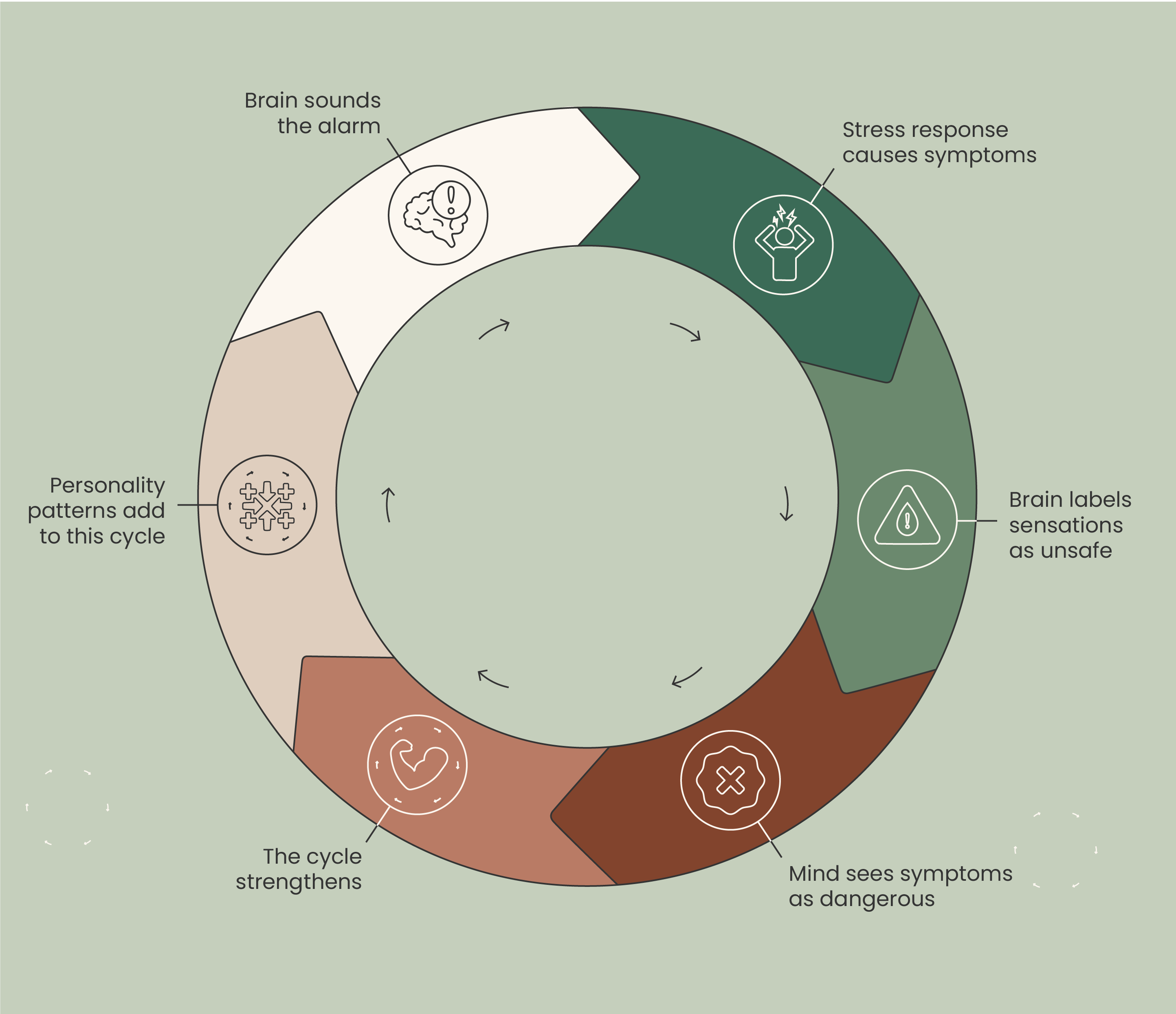
One of the most powerful things I learned in my own recovery, and something I now watch people discover again and again through Befriend, is just how deep our influence can go in our recovieries.
By influence I do not mean control. I am very deliberate about that distinction and you will learn the crucial and life changing difference with us in our community. We cannot control every sensation our body produces, every stressor we encounter, whether we become ill, what happens to us, or how quickly a brain and body change. But our influence is much bigger than many of us have been taught to believe.
For a long time, I experienced symptoms as things that simply happened to me. Fatigue happened. Pain happened. Dizziness happened. My body would react, and then my conscious mind would arrive like a scared meerkat, desperately trying to work out what on earth had just gone wrong. It would produce 6,000 frightening thoughts, explanations and predictions about what my symptoms meant and what might happen next. At the time, I took these thoughts as truth because they seemed like perfectly logical conclusions based on what my body was doing.
What I couldn't yet see was the enormous amount of processing already happening outside my conscious awareness. Our brains are prediction machines, continuously integrating information from the body and our environment with previous experiences, emotions, beliefs, expectations, memories and context, then making their best prediction about what is happening and what response is needed.
Our experience of the body is not simply a passive read-out of signals coming from it. This means that symptoms which feel as though they “just happen” can sometimes be the output of deeply learned predictive processes, while our conscious mind then adds another layer of meaning and prediction on top. Understanding that opened up an extraordinary amount of possibility for me, because processes that have been learned can also be influenced and updated.
When we talk about neuroplastic symptoms, it is tempting to reduce everything down to a frightened nervous system that needs to be “regulated”. I think that is vastly incomplete and indeed a lot of it is hyper simplified crap, sold by a predatory online wellness space that is under qualified to work with people.
You are not a nervous system floating around independently of a mind, history, relationships, beliefs, behaviour and life. The mind is embodied and relational meaning the mind directly impacts the brain, is not separate from the body or from our relationships. How we interpret what happens to us changes physiology. What we expect influences perception. What we pay attention to changes what the brain prioritises. Our emotional learning influences what the brain identifies as significant. Our behaviour provides the brain with information about what is dangerous and what is not.
Even our personality patterns can become part of this predictive landscape.Perhaps you learned very early to anticipate what everyone else needed before noticing what you needed. Perhaps uncertainty sends your mind into hours of planning, researching and trying to eliminate every possible bad outcome. Perhaps you are enormously conscientious and experience mistakes as threatening. Maybe your internal voice has spent twenty years pointing out everything you are doing wrong. Perhaps you push through exhaustion, then collapse, then become frightened by the collapse and avoid activity until you feel certain it is safe again.
Maybe you habitually suppress anger, over-help, people-please, catastrophise sensations, scan your body, struggle to tolerate disappointment, fear conflict, overwork, overanalyse, or try desperately to control uncertainty. None of this means you have caused your illness. It means that a human brain learns from the whole bloody lot!
These ways of digesting life can become so automatic that we don't experience them as patterns at all. They simply feel like us. Yet they can repeatedly provide the brain with information about threat, urgency, uncertainty, helplessness or danger, and over time those predictions can become very well learned. This is one reason I get so frustrated when I see recovery programmes promising that if you do “x” you will get “y”, or suggesting recovery should happen in 30 days or three neat levels. For many of us, that simply adds another layer of pressure. We start “doing recovery” like we are back at school, trying to get it right, complete the exercises and reach the next level, without noticing that this very urgency, perfectionism or fear of getting it wrong may be part of what our brain is learning from. Recovery is much more individual than that. It asks us to begin noticing our own unique ways of meeting ourselves, our symptoms and our lives, then gently shaping those patterns in small, kind, everyday ways that reduce unnecessary anxiety and stress and give the brain different information to learn from. Over time, that can help change the processes contributing to symptoms too.
Predictive processing gives us a useful framework for understanding this. Your brain is constantly generating predictions and comparing them with incoming sensory information. When reality differs from the prediction, the difference is called a prediction error. Ideally, those errors help the brain update its model.
But learning does not always update neatly. Strong expectations, fear, previous experiences, medical information, social media wellness misinformation, attention and repeated behavioural responses can all influence how sensory information is interpreted and how much weight different signals receive. A prediction can become increasingly convincing precisely because the brain keeps finding, attending to or generating experiences that appear to confirm it.
Imagine someone repeatedly experiencing dizziness when entering a supermarket. Initially there may have been very good reasons for it: illness, sensory overload, exhaustion, vestibular dysfunction, panic, or some combination of factors. But the brain learns associations extraordinarily well. Eventually, supermarket can begin to predict dizziness. Bright lights can predict dizziness. Standing in the queue can predict dizziness. Thinking about going to the supermarket can begin to activate elements of the same learned response.
The person isn't imagining their symptoms. The symptoms themselves are 100% real. What has changed is our understanding of how a real physical experience can be generated. And some fascinating research is beginning to demonstrate just how far these predictive processes can reach.
A 2025 Nature Neuroscience study led by Sara Trabanelli exposed healthy participants to virtual-reality avatars displaying signs of infectious illness. The avatars were not actually infectious, of course. Yet as the apparently infectious avatars approached the participants' personal space, the brain anticipated the potential threat. Researchers detected changes not only in brain activity but in components of the innate immune response, including changes in innate lymphoid cells.
The immune response was totally real but the infectious threat was virtual. That does not mean inflammation is imaginary, or that all immune dysfunction is generated through prediction. What it shows is that the brain, mind, and immune system are in continuous conversation, and what the brain perceives and predicts can influence measurable physiology.
Another recent study gives us an equally fascinating glimpse into symptom generation. Yotam Yanai and colleagues studied 13 people experiencing persistent headache and dizziness following concussion. Instead of exposing participants to their usual physical triggers, researchers asked them to imagine the movements or situations that normally provoked their symptoms. Nine of the 13 developed headache. Eleven developed dizziness.
Nobody had performed the triggering movement. Their brains were responding to its mental representation. It is a small case series. But as part of a much larger emerging literature on perception, expectation, pain and predictive processing, it is incredibly interesting.
Similar provocative-testing work in Long COVID has reported symptoms occurring during imagined exposure to previously symptom-provoking activities. Again, this doesn't tell us that every symptom in Long COVID is neuroplastic, nor does it erase immune, vascular, autonomic, metabolic or other biological contributors. It demonstrates something much more specific: in at least some people, that learned prediction appears capable of participating in the production of very real physical symptoms. This is why we have so many people now recovered from long covid in Befriend. Again, 100% real symptoms, and, able to be healed with caring for mind, brain AND body (we do not believe in this whole regulate your nervous system and forget your physical needs thing you see on social media!)
We still have this peculiar cultural habit of dividing people into a body and a mind, as though thoughts happen in some little cloud hovering above the skull while the “real” biological business happens below the neck. It is bonkers when you think about it. because a thought is a biological event. An expectation involves brain activity. Remembering, imagining, worrying, interpreting, attending and anticipating involve neural processes that interact with autonomic, endocrine, immune and motor systems.
This is one reason (of many) that we don't simply teach “nervous system regulation” in Befriend. Somatic work can be incredibly useful. Learning to notice sensations differently, developing interoceptive awareness, working compassionately with protective responses, allowing emotion, using somatic tracking and becoming less frightened of physiological activation can all be valuable.
But if we only work from the neck down, we are leaving out an enormous part of the human system. If I spend twenty minutes doing a beautiful somatic practice and then spend the remaining eleven waking hours catastrophising symptoms, relentlessly monitoring my body, believing activity is damaging me, treating uncertainty as an emergency, overriding my needs, criticising myself, fearing emotions, people-pleasing myself into exhaustion and organising my life around avoiding anything that might make symptoms worse, my brain is learning from those eleven hours too.
This is why our work goes much wider. We become curious about how you think. What you believe. What you predict. How you respond to symptoms. How you relate to uncertainty. What your attention repeatedly returns to. What you learned about emotions. What happens when you make a mistake. Whether you habitually push, avoid, appease, freeze, fight, perfect, rescue or control. What medicine has taught you to expect from your body. What previous experiences taught your brain to protect you from.
This is so that you can begin to see where your influence actually lives - and this is exciting because all these things can be gently shaped without it being very complex at all, but with taking time, and practice.
A fascinating 2026 paper by Steven Kotler, Michael Mannino, Glenn Fox and neuroscientist Karl Friston explores trauma through predictive coding and the concept of metastability, essentially the brain's capacity to move flexibly between different states rather than becoming trapped in a narrow repertoire of responses.
Their argument is provocative. Rather than thinking about the body as literally storing a fixed “score” of previous trauma, they propose thinking about the brain as continuing to predict from what it has learned. When predictions become rigid, present experience can keep being interpreted through an old model. There are aspects of this model that remain theoretical, and the authors themselves acknowledge important gaps in the direct evidence. It shouldn't become another neuroscience slogan that we treat as proven simply because it sounds compelling.
But I do love the broader principle of flexibility which is emerging in more and more scientific findings. Healing doesn't require pretending that difficult things never happened. Nor does it mean telling ourselves that everything is safe when it isn't. Our brains are supposed to detect danger. Our bodies are supposed to respond to infection, injury, stress and threat. What can change is rigidity.
The brain can discover that something which used to predict danger no longer does. That a sensation can mean more than one thing. That physical activation doesn't inevitably end badly. That uncertainty can be tolerated without hours of mental problem-solving. That movement can sometimes be uncomfortable without being damaging. That an emotion can move through us without overwhelming us. That rest doesn't mean failure, activity doesn't mean danger, and a symptom flare doesn't automatically mean we are back at square one. Those aren't positive affirmations or brain retraining programs pasted over reality. They are new experiences from which the brain can learn.
Understanding predictive processing intellectually is lovely. I am a massive neuroscience nerd, so I will happily talk about it all day. But your brain needs experience to update, not you scrolling on social media or endlessly researching labels to say 'aha, this is why I experience difficulty'
This is why we practise noticing where we have influence. You can notice the catastrophic prediction and begin responding differently. You catch yourself treating uncertainty as an emergency. You notice when perfectionism has quietly turned an ordinary Tuesday into an incredibly pressured Olympic event. You practise somatic tracking and discover that a sensation can change when you meet it with curiosity rather than immediately trying to get rid of it. You experiment gently with something you have been avoiding. You feel anger and discover that you don't fall apart. You respond compassionately after a difficult day rather than telling yourself you have ruined your recovery. And often slowly, but sometimes remarkably quickly and sometimes maddeningly gradually, the brain gathers different evidence, and our symptoms change.
There is an expanding scientific conversation around brain-generated and neuroplastic symptoms. Rehabilitation physicians Christine Gou and John Metzler recently reviewed the clinical science around neuroplastic pain, while Alexandra Thérond, Louisia Starnino and Christopher Robinson have proposed that successful pain-reprocessing treatment depends on far more than simply identifying pain as neuroplastic. Cognitive readiness, behaviour, provider messaging and the wider healthcare system can all influence whether new learning becomes possible.
I think this wider lens is desperately needed. We don't need another wellness culture that teaches people they have failed because they couldn't “regulate their nervous system” hard enough. Nor do we need to tell people that every chronic symptom is psychological, that structural and biological disease don't matter, or that changing your thoughts magically cures illness.
Bodies are biological. Minds are biological. Relationships are biological. Learning is biological. Environment matters. Illness matters. Nutrition, sleep, hormones, infection, injury and physical conditioning matter. So do beliefs, expectations, emotion, attention, behaviour and previous experience. We are a dynamic biopsychosocial system.
For those of us whose symptoms have become partly maintained through learned predictive processes, this gives us places where we can actively participate in our health and wellbeing. Not perfect control. Influence. To learn more about this very crucial backbone to recovery, please join us in the community. Your brain has learned from your life, and, throughout your life, it remains capable of learning again.
Trabanelli, S., Akselrod, M., Fellrath, J., et al. (2025). Neural anticipation of virtual infection triggers an immune response. Nature Neuroscience, 28, 1968–1977.
Yanai, Y., Gefen-Doron, D., Sivan-Speier, K., Ohry, A., & Gimmon, Y. (2026). Headache and dizziness provoked by mental imagery in patients with persistent postconcussive symptoms: A case series. Journal of Head Trauma Rehabilitation.
Kotler, S., Mannino, M., Fox, G., & Friston, K. (2026). The body does not keep the score: Trauma, predictive coding, and the restoration of metastability. Frontiers in Systems Neuroscience, 20, 1812957.
Gou, C. Y., & Metzler, J. P. (2026). Understanding neuroplastic pain: Clinical implications for diagnosis and treatment.ASRA Pain Medicine News, 51.
Thérond, A., Starnino, L., & Robinson, C. L. (2026). Proposed conditions for Pain Reprocessing Therapy readiness: Beyond phenotyping neuroplastic pain. Current Pain and Headache Reports, 30, 82.
.svg)



