
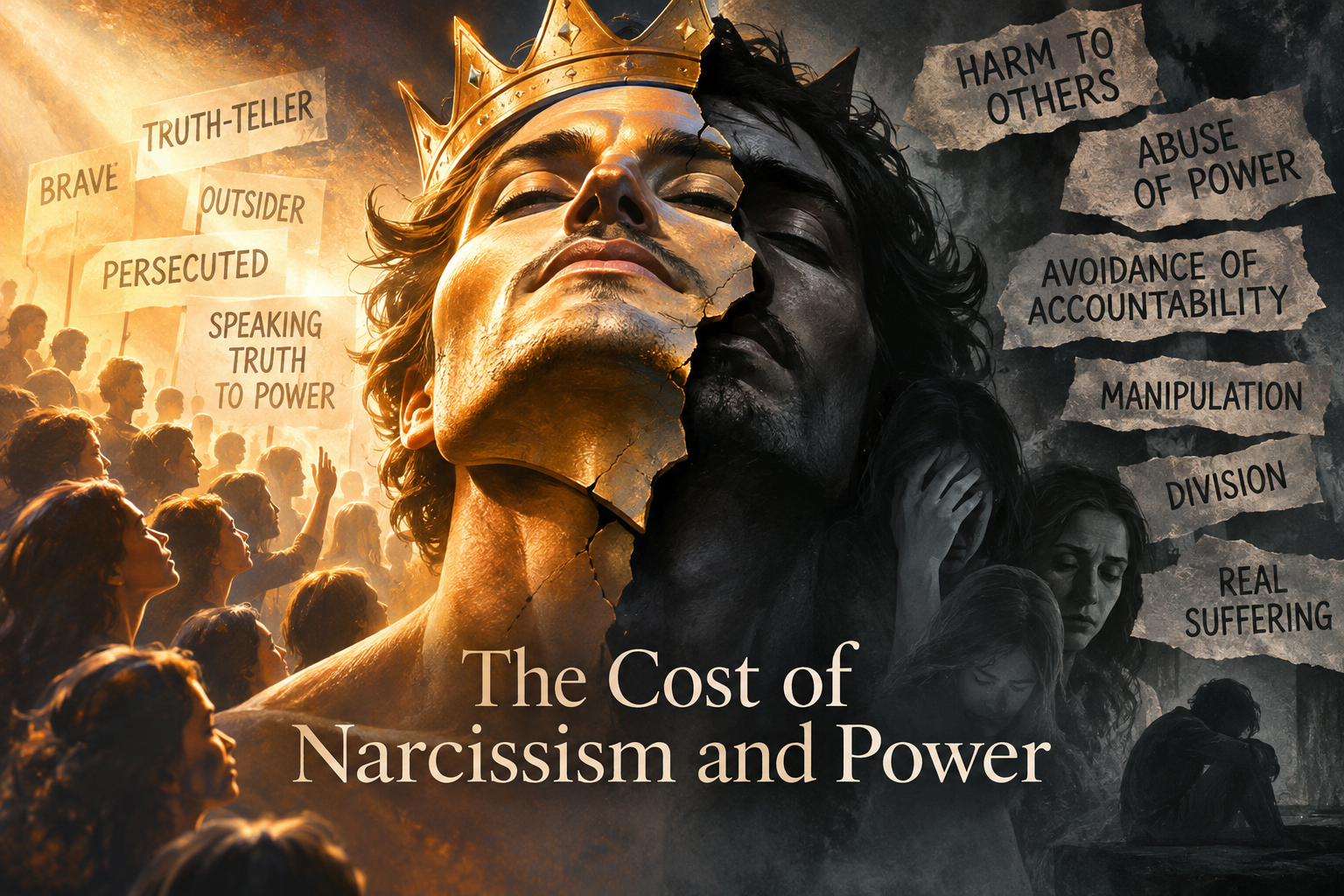
One of the most effective ways powerful people avoid accountability is by convincing us that they are the ones being persecuted. Rather than answering difficult questions about their behaviour, which is called accountability, they redirect our attention towards the supposed injustice of being questioned at all. And very often in our society, it works.
What strikes me about the people defending Russell Brand is how readily some accept his narrative that “the establishment is against me,” without recognising that this kind of persecution narrative can itself function as a grandiose smokescreen. The focus shifts away from the allegations and the people who have made them, towards the supposed victimhood of the man facing scrutiny.
We see something similar with Andrew Tate, whose narrative about “the Matrix” trying to silence him has become central to his public identity. Donald Trump has repeatedly framed investigations, criticism and legal proceedings as evidence that powerful institutions are conspiring against him. Despite occupying one of the most powerful positions in the world, he has successfully cultivated an image of himself as a persecuted and victimised outsider fighting on behalf of ordinary people.
These men are different, and the allegations, evidence and legal findings concerning each of them must be considered separately. But the rhetorical pattern is strikingly similar. I think it tells us something important about our cultural relationship with narcissism, power and accountability that at this time in the world, we should be questioning and actively deconstructing.
Psychologically, what's fascinating is how these narratives can become almost impossible to challenge once someone has invested in them. Allegations become evidence of a conspiracy. Criticism becomes proof that the individual is threatening powerful interests. Legal proceedings are interpreted as persecution. The more serious the scrutiny, the more heroic the person can appear to their followers.
This creates a remarkably effective defence against accountability because the narrative can absorb almost anything. Evidence that might ordinarily prompt someone to reconsider their position is reinterpreted as further confirmation that they were right all along.
Several psychological processes help explain this, including motivated reasoning, confirmation bias and cognitive dissonance. Throughout our lives, we develop beliefs about ourselves, other people and how the world works, shaped by our families, education, religion, culture and personal experiences. These become the mental frameworks through which we interpret new information. We naturally tend to notice and accept information that confirms what we already believe, while information that challenges those beliefs can create psychological discomfort. This discomfort is known as cognitive dissonance, particularly when we are confronted with evidence that conflicts with beliefs or commitments we hold strongly.
Rather than reconsidering those beliefs, we may unconsciously dismiss, minimise or reinterpret the evidence to preserve our existing understanding of the world. And the more closely a belief is tied to our identity, values or sense of belonging, the harder it can be to question. Defending the individual can become a way of defending themselves. This is particularly powerful when a charismatic figure has positioned themselves as someone who sees truths that ordinary people cannot. Followers may begin to experience their loyalty as evidence of their own intelligence, independence and willingness to question authority. Ironically, people who pride themselves on thinking critically about powerful institutions can end up granting almost unquestioning authority to a single charismatic individual.
I think we also need to examine how much we have normalised, and sometimes actively celebrated, narcissistic traits in positions of power. Grandiosity can be mistaken for confidence. Dominance for leadership. Arrogance for conviction. An unwillingness to accept criticism for courage. Someone who refuses to be questioned can appear extraordinarily powerful, particularly to people who feel powerless themselves.
And our culture frequently rewards these performances. We are drawn to people who seem certain, who speak with authority, who promise simple explanations for complicated problems and who appear untroubled by the doubts and vulnerabilities that most of us experience.
To me, there's something quite tender beneath this attraction. Life is inherently uncertain. We cannot control outcomes, only influence them. We are all vulnerable, fallible and mortal, and these are not always easy realities to live with, particularly if we grew up without enough support to understand, tolerate and care for our own vulnerability. Grandiose figures can appear almost immune to the very things we struggle with internally. Their certainty, dominance and apparent invulnerability may offer a kind of psychological shield against our own fears and feelings of powerlessness. We can unconsciously borrow their confidence rather than develop a more compassionate and realistic relationship with our own uncertainty.
Perhaps this is part of why we can become so invested in protecting them. Questioning their invulnerability may bring us face to face with the vulnerability we were hoping, through them, to escape.
One particularly troubling feature of the narratives defending these men is the way they can reverse our attention from the people reporting harm to the person accused of causing it. In discussions of interpersonal abuse, the term DARVO describes a pattern in which someone denies wrongdoing, attacks the person raising concerns and reverses the roles of victim and offender. The concept is useful here as a way of understanding a possible rhetorical pattern, although it should not be applied automatically to every public dispute or treated as proof of guilt.
The mechanism is relatively simple. Instead of examining the original behaviour, the conversation becomes dominated by how unfairly the accused person is supposedly being treated. Suddenly, the central question is no longer whether someone has harmed another person, abused their position or acted dishonestly. We are debating whether they have been misunderstood, unfairly criticised or targeted by enemies.
Donald Trump provides a particularly significant example because his persecution narratives coexist with enormous institutional power and established legal findings. A civil jury found him liable for sexually abusing E. Jean Carroll, yet his wider political messaging has repeatedly encouraged supporters to interpret legal scrutiny through the lens of political persecution. The existence of political motivations, institutional bias or unfair treatment should always be open to examination. But those possibilities do not automatically invalidate evidence, erase legal findings or remove someone's responsibility for their actions. The same standard of scrutiny must apply to the powerful as to everyone else.
In his own autobiography, My Booky Wook, Russell Brand describes how, as a child, he would lure his dog, Topsy, to the top of the stairs, kick her back down, then follow her downstairs to cuddle and comfort her, pretending to sympathise with what had happened. He describes repeating this behaviour. The deliberate invitation to trust, followed by cruelty, followed by affection from the very person who inflicted the harm. As a therapist, I find that sequence deeply disturbing, particularly because alternating harm and affection can create such profound confusion in abusive relationships.
Elsewhere in his memoirs, reflecting on his treatment of women, Brand asks readers to imagine what he has left out if this is what he is willing to disclose. These are his own published accounts, offered to the public long before the current scrutiny of his behaviour. And yet so much of the conversation around Brand has centred on whether he is being victimised by powerful institutions. This is precisely the smokescreen I'm talking about. We become so invested in someone's charisma, their apparent honesty or their claims of persecution that we risk overlooking what they have actually told us about their behaviour, and what others have reported experiencing at their hands.
We need to become much better at distinguishing public confession from meaningful accountability, and charisma from character. Particularly when the people asking us to defend them already hold enormous influence.
There are legitimate reasons to distrust powerful institutions. I certainly do! Governments, corporations, media organisations and legal systems have all, at different times including at the moment, protected influential people, concealed wrongdoing and failed those who were harmed. That history makes persecution narratives persuasive because they draw upon something real. Institutional power is regularly abused, dissent is suppressed globally in many places, and allegations can be mishandled or punished. Speaking truth to power is indeed dangerous for many people.
But I think our distrust of institutions should make us more discerning, not less. If someone tells us that powerful interests are conspiring against them, we can examine that claim while still asking what they are being accused of, what evidence exists, how they have responded and whether their account withstands scrutiny.
We can also pay attention to what happens when difficult questions are raised. Does the person engage with the substance of the concern? Do they acknowledge any responsibility? Are they willing to be held to the same standards they demand of others? Or does every challenge become another opportunity to portray themselves as the victim? To hold a high ground of knowing things others don't. Of claiming spiritual superiority.
These questions are especially important when someone has a large audience, considerable wealth, political influence or social authority. The greater someone's power, the more important it becomes that their public image does not replace meaningful scrutiny of their conduct. For me this is the glaringly obvious flaw in their plan. These are all people with wealth, privilege, and power. Have a look at what they do in their communities and lives in real, tangible terms, for people they claim their rhetoric is for. Andrew Tate uses his money to rent cars and fund lifestyle, Russel Brand's YouTube earnings from speaking about 'the system' is used to fund his lifestyle, Donald Trump has made 2.5 billion since being in office his second term, which funds his lifestyle. I think when you are willing to look at where actions align with words, or not, it gets quite clear whether we should trust people or not.
Perhaps the most unsettling aspect of all this is how effectively the performance of persecution can itself become a form of power. Someone can position themselves as the courageous outsider while wielding extraordinary influence over how millions of people understand events, whom they trust and whose suffering they take seriously. Their voice sounds like 'the truth'
But this should not automatically be confused with speaking truth to power. Genuine acts of speaking truth to power often come at considerable personal cost, motivated by a commitment to justice, integrity and the freedom and dignity of others. Martin Luther King Jr., Vandana Shiva, Daniel Ellsberg and Malala Yousafzai offer different examples of people who have faced serious personal consequences for challenging powerful institutions or entrenched systems. Their circumstances and methods differ, but each illustrates the risks that challenging power can involve.
I think there are some important distinctions we can look for. These figures are primarily drawing attention to injustices beyond themselves, rather than making their own persecution the centre of their message. Their advocacy is directed towards broader principles, including human rights, equality, access to knowledge and environmental justice. We can also examine the relationship between their words and actions, the personal costs they have been willing to bear, and whether the freedoms and rights they advocate extend to others, including those who disagree with them.
And importantly, what do people actually do with the power, privilege and status they hold? I often think of Senator Bernie Sanders when I teach about this. I'm neither Republican nor Democrat; I'm libertarian. But Sanders is someone whose political career offers a useful example of consistency between publicly stated values and long-term advocacy. For decades, he has championed policies intended to improve healthcare access, workers' rights and economic security for ordinary Americans. He is a white man who holds considerable institutional power and privilege, and much of his political work has focused on using that position to advocate for people with less influence. He lives a safe life yes, and also, not a showy one, and he seeks no adulation. He lifts up others. We don't have to agree with his policies to see the evidence of that steady commitment.
This is what I encourage people to look for when evaluating integrity. Does someone's concern for justice extend beyond their own interests? Do they use their influence to expand opportunities and protections for others? Are their values reflected in sustained action, including when doing so carries a personal cost? And are they willing to be held accountable to the same principles they advocate? These are far more meaningful questions than how confidently someone speaks or how convincingly they present themselves as a courageous outsider.
Integrity doesn't require someone to be flawless, and none of these figures should be beyond criticism. But it does invite us to look for consistency between professed values and actual behaviour, a willingness to be accountable, and a commitment to principles that extend beyond personal status, influence or self-interest. Someone's willingness to suffer for a cause may demonstrate conviction, but what they are fighting for, how they pursue it and how they treat others along the way are equally important.
We need to be mindful of how easily we can become captivated by the performance of strength, to the point that we stop examining how power is actually being used. When that happens, we risk becoming participants in protecting the very behaviour we might otherwise condemn. Critical thinking requires us to question the charismatic rebel just as rigorously as we question the establishment they claim to oppose. It means retaining our capacity to examine evidence, tolerate uncertainty and change our minds, even when doing so is uncomfortable. Claiming to be persecuted should never, by itself, make someone more credible. What deserves our attention is the evidence, the integrity of someone's actions, how they treat others and whether they are willing to be held accountable for the power they wield.


